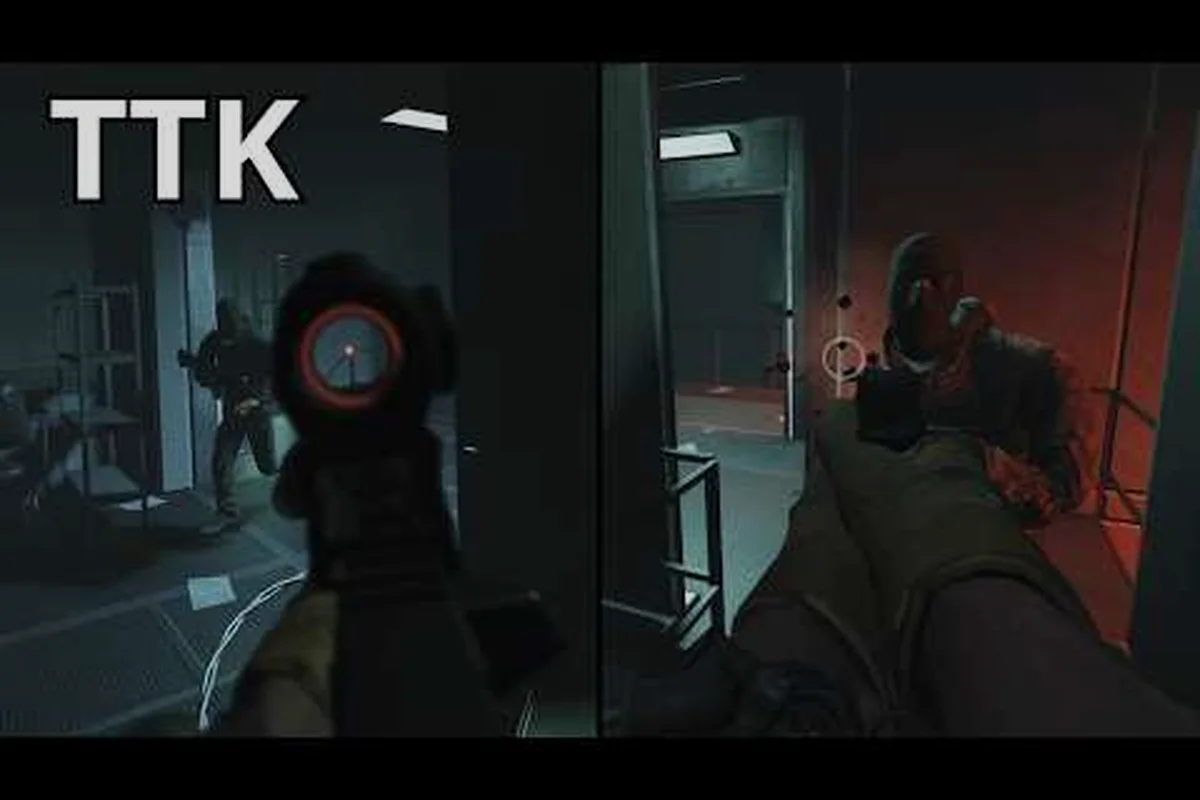
Understanding the TTK Testing PVE vs PVP difference is essential before queuing your first match, because the two halves of this tactical Roblox shooter use completely different pacing, objectives, and team setups. The PVE side pushes planned squad co-op survival and doorkicker-style missions, while the PVP side drops you into live FFA, Hardpoint, and Ground War firefights against human opponents on a map voting rotation. This guide breaks down every meaningful gap between those modes so you know exactly what changes when you swap from solo bot-grinding to team-based competitive play.
PVE Side of TTK Testing: Coop Survival and Story Missions
The PVE pillar in TTK Testing is built around two planned experiences: Survival waves and linear doorkicker-style Missions. According to the official TTK Testing DevForum roadmap, the PVE track is being developed in parallel with team-based PVP, but each mode is tuned with a different mindset. On the PVE side, AI enemies behave on predictable scripts, giving squads a chance to learn bullet drop, recoil, and pre-aiming before the chaos of human PVP enters the picture.
Coop PVE Survival and Squad Play
The Survival variant of ttk testing coop pve throws waves of AI combatants at a squad and asks them to hold ground, manage ammo, and rotate cover as the pressure ramps. The full mode is being staged on the V0.x roadmap, so live playtests today are more limited than the eventual vision, but the early community testing already shows a clear set of behaviors that separate this from PVP. Enemies in PVE never mind-map your flanks the way a human would, they are slower to punish a missed pre-aim, and they drop on a more forgiving damage curve because the encounter is built to last long enough for a squad of 2-4 to coordinate.
ttk testing squad play is therefore more about roles than raw aim duels. A typical PVE squad breaks into a point player, a flanker, and a rear guard watching for breaching AI, which mirrors real doorkicker protocol more than the lone-wolf pattern FFA rewards. The community's full gameplay walkthrough on YouTube shows the current test maps in their low-light night configuration, which is the most common PVE sandbox during these early builds. A useful table for planning your PVE squad roles looks like this:
| Role | Primary Job | Recommended Loadout Hint | Why It Matters in PVE |
|---|---|---|---|
| Point Player | First through the door, clears near contact | Close-range rifle or SMG | Engages AI first, sets tempo |
| Flanker | Side angle on grouped enemies | Medium-range optic | Breaks AI clustering |
| Rear Guard | Watches six, handles flanks | Suppression or utility | Catches the AI that bypasses the point man |
| Flex | Adapts to squad gaps, revives teammates | Any balanced kit | Smooths the wave when roles overlap |
A second comparison helps explain how PVE and PVP differ in pacing and pressure, and it frames why the same TTK number feels wildly different across modes: in PVP FFA on the ttk testing ffa map, a 0.35s kill window is razor-thin because human opponents will pre-aim, counter-strafe, and read your spawn, so every millisecond of reaction time is contested, whereas in PVE Survival the same weapon's TTK stretches out across forgiving AI health pools and scripted wave timers, meaning positioning, ammo economy, and role rotation matter more than raw time-to-kill, which is exactly the gap the next table makes visible.
| Dimension | PVE Survival / Missions | PVP FFA / Hardpoint |
|---|---|---|
| Primary Opposition | Scripted AI combatants | Live human players |
| Match Length | Long-form, wave-based or scripted | Short rounds, 5-15 minutes |
| Damage Curve | Forgiving, tuned for squad longevity | Lethal, tuned for realism |
| Information Game | Audio cues and callouts dominate | Radar, line of sight, and spawn reads |
| Best Squad Size | 2-4 coordinated players | 1-8 depending on mode |
| Primary Skill | Positioning and resource management | Aim, timing, and map control |
Story-Based Doorkicker Missions
The Missions track is the second half of the PVE experience and focuses on linear, scripted breaches. As noted on the official Roblox game page for TTK Testing, the roadmap is explicit that Missions will lean on doorkicker mechanics, the kind of room-clearing flow that emphasizes stack discipline, flash-then-clear order, and tight crossfire. Because these are scripted encounters, every squad that runs the same mission sees the same opening spawns, the same enemy counts, and the same objective order, which makes Missions ideal for practicing rotations before jumping into PVP.
A practical pre-mission checklist for the PVE pillar looks like this, designed specifically around the doorkicker flow that Missions track uses for scripted room-clearing encounters. Because the same squad composition, same opening spawns, and same objective order repeat every run, the checklist acts less like a generic preparation list and more like a repeatable script you can drill across the Missions track before graduating to the FFA map or Hardpoint rotation in PVP, where unpredictable enemy players replace scripted AI.
-
Confirm your squad has a designated point player and rear guard before the breach timer starts.
-
Check that everyone has the Helmet Cam keybind mapped to P, since the official description flags this as the default first-person view.
-
Make sure the Transparent Optics aiming setting is enabled in Settings so you can practice both-eyes-open aiming.
-
Pre-call utility usage so the team knows who throws flash, who throws smoke, and who leads the stack.
-
Save a revive for the rear guard rather than the point player, because the rear guard sees the next threat first.
PVP Side of TTK Testing: FFA, Hardpoint, and Ground War
The PVP pillar is where the game earns its tactical-FPS reputation. Live playtests rotate between FFA, Hardpoint, and the larger Ground War mode, all of which sit on the same map voting layer and use the same weapon tuning pass that the V0.03 update walkthrough showcased on YouTube highlighted. The most realistic-feeling tactical FPS comparison in the community comes from this 16-minute gameplay review, which shows how tight the time-to-kill actually feels when both sides are pulling real trigger discipline.
FFA Map and Solo PVP Play
A ttk testing ffa map puts every player on the same side and drops them into a free-for-all with respawn flow controlled by the map's spawn logic. Because there is no squad to watch your six, FFA reads more like a chess clock than a coordinated push: every engagement costs you map position, every death is information for the next enemy you meet, and map control becomes a math problem rather than a callout problem. The official description notes that the game supports PC, mobile, Xbox, and PS5, but the FFA experience is currently tuned around mouse-and-keyboard parity, so console players tend to lean on aim assist settings when crossing into PVP.
A quick reference for the most common FFA mental model in ttk testing ffa map: treat each life as a 30-to-45-second chess clock where respawn flow hands you back into the next duel before your prior death animation finishes, so the question is never "did I out-TTK him" but "did I win the trade before the next player's footsteps registered on my minimap." Because the map removes squad revive, callouts, and objective anchoring, the same TTK values that feel punishing in ttk testing coop pve feel generous here once you factor in positioning, audio cues, and the rotating-spawn timer — which is why solo PVP testing is the cleanest sandbox for isolating raw gunplay delta rather than role-combo synergy.
-
Open rounds: 6-12 players, short spawn windows, no respawn tickets.
-
Spawn flow: rotating spawns per kill rather than fixed safe zones.
-
Tactical read: every sound is a player, every corner is a duel, every utility throw is a commitment.
-
Recommended for: warming up aim, learning map callouts, and practicing 1v1 isolation duels.
Hardpoint Capture Zones in PVP Play
A ttk testing hardpoint map flips the script from FFA by adding a hard objective: a single capture zone that rotates around the map on a timer, and a team has to be inside it to score. This is where team-based PVP shows its teeth, because the Hardpoint reward loop punishes players who chase kills without holding ground, and rewards squads that time their pushes to the rotation tick. The community's full gameplay walkthrough shows how the Hardpoint capture circle moves between long sightlines and tight indoor pockets, which is a useful pattern to memorize for solo queue.
A side-by-side view of FFA versus Hardpoint priorities makes the contrast sharp: on a ttk testing ffa map, every millisecond of TTK matters because there is no respawn safety net, so a duel lost to a slower AR or a mistimed slide-cancel instantly ends the round, whereas on a ttk testing hardpoint map the same gunfight can be a net win for the team holding the zone if the kill trade happens off-point and the clock keeps ticking for the squad inside the capture circle. That single rule — kills are currency in FFA, time-on-zone is currency in Hardpoint — is the reason the priorities table below diverges so aggressively on spawn logic, engagement range, and risk pattern, and why players grinding ttk testing pve pvp difference benchmarks see their loadout and rotation choices shift completely when they switch match types inside the same ttk testing private match lobby.
| Priority | FFA Map | Hardpoint Map |
|---|---|---|
| Objective | Last man standing | Hold the active capture zone |
| Best Engagement | Isolated 1v1 duels | Coordinated 2v2 inside the zone |
| Spawn Logic | Spread to avoid chain deaths | Tight to favor the team holding the zone |
| Risk Pattern | Off-angle peek, no commitment | Overextend punish, time-on-zone matters |
| Win Condition | High kill count, no respawns | Highest total time-on-zone at the clock |
Map Voting and Private Match Layer in TTK Testing
The connective tissue between PVE and PVP is the ttk testing map voting mode layer and the ttk testing private match option. Map voting is the community-driven phase that runs between rounds: players vote on which map the next match uses, and the top vote-getter cycles into the rotation. Private match lets you lock the lobby to a known squad, lock the mode, and lock the map, which is the cleanest way to grind PVE missions with friends without random fills. Whenever you want to swap weapon balance or stress-test spawn timings, jump into a Ttk Testing Ffa lobby to get repeatable, no-consequence duels before queuing that next rotation match.
How Map Voting Mode Works
Map voting reads on three inputs: a short list of map options shown between rounds, a vote window of roughly 10-15 seconds, and a results screen that announces the next map. According to the official roadmap, voting is part of the broader feature set the developers are staging alongside teams, spectating, and launchers. For solo players who want a quick PVP rotation, voting is the single best way to learn map flow because you consistently land on the maps the community prefers, and those maps are usually the most balanced for tactical play.
The voting cycle runs on a fixed loop tied to round transitions, not a global lobby clock: each map ends when the win condition triggers (objective capture timer, kill limit, or hardpoint rotation), then a 5-second intermission hands off to the vote screen, which stays open for 10-15 seconds depending on the playlist, and finally a 3-second reveal locks in the winner before the next match loads. In a standard 4v4 hardpoint rotation, that means roughly 3-4 minutes of gameplay followed by 18-23 seconds of voting screens, so plan your TTK comparisons across at least 3 full cycles to smooth out spawn variance and map-specific weapon balance shifts, especially when testing the PVE vs PVP TTK difference where PVE sandbox lobbies run shorter co-op waves without a vote screen at all.
| Step | What Happens | Player Action |
|---|---|---|
| Round End | Match ends, results screen flashes | Read the scoreboard, prep for vote |
| Vote Open | Map options appear, timer starts | Pick the map that fits your squad comp |
| Vote Close | Votes tallied, winner shown | Pre-aim for the incoming map |
| Match Start | New map loads with chosen mode | Execute the plan from spawn |
How Private Match Ties Squad Play Together
ttk testing private match is the cleanest way to run a planned PVE session or a scrim-style PVP set. Because the lobby is locked to invited players, you can stack roles, test loadouts, and rehearse doorkicker breaches without random fill interference. Private match is also the safest sandbox for testing the time-to-kill changes that arrive in each V0.x update, because you control the round count and can isolate one weapon at a time.
A short use-case table makes the squad-level value of private match concrete: it shows how the same lobby configuration can flip between a PVE mission rehearsal (where AI spawns and revive timers behave like the live V0.x build) and a PVP scrim (where two stacks of five run a FFA map or hardpoint map with a fixed round count), letting the squad isolate one variable — weapon, map, or role — per session without the contamination of random fill or matchmaking variance.
| Use Case | Why Private Match Helps |
|---|---|
| PVE Mission Rehearsal | Locks the squad, lets the team stack roles and callouts |
| PVP Scrim | Sets round count, lets two squads practice a single map |
| Weapon Tuning Test | Eliminates random fill, isolates one weapon per session |
| Map Voting Practice | Lets a squad pre-agree on vote priorities |
| New Player Onboarding | Senior players can coach in a controlled lobby |
Which Mode Should You Pick First in TTK Testing?
The right entry point depends on whether you want to learn the game's mechanical feel or its competitive pacing. New players who want the smoothest onboarding should start with PVE Survival and Missions, because AI pressure gives you space to learn recoil, bullet drop, and the Helmet Cam view without the instant punish of a human duel. Players who already have tactical-FPS experience and want to feel the time-to-kill tuning pass immediately should queue straight into FFA on a ttk testing ffa map, then layer in Hardpoint once the spawn logic feels intuitive.
A simple decision table helps you pick the right starting mode, but the underlying logic is worth understanding before you scroll: TTK Testing's PVE and PVP modes share weapon tuning and map voting infrastructure, so your choice is really about which TTK curve you want to internalize first. PVE modes use a flattened damage curve with scripted AI pressure and forgiving respawn timers, letting you practice recoil reset, bullet drop compensation, and Helmet Cam tracking without spawn-death penalties. PVP modes like FFA and Hardpoint on a ttk testing ffa map or ttk testing hardpoint map expose the full, lethal time-to-kill tuning, with human aim duels and ttk testing map voting mode letting the lobby pick the arena before each match—making them ideal for measuring true ttk testing pve pvp difference under live conditions rather than against predictable AI.
| Player Type | Recommended First Mode | Reason |
|---|---|---|
| Brand new to tactical shooters | PVE Survival | Forgiving damage curve, learn mechanics |
| Returning FPS player | FFA map | Fast 1v1 duels, learn map callouts |
| Squad of 2-4 friends | Hardpoint map | Team-based play, objective focus |
| Coach onboarding a new player | Private match PVE | Controlled environment, role clarity |
| Pre-rotation warmup | Quick Play FFA then Hardpoint | Mixed pacing, builds game sense |
A final comparison summarizes the gap between the two halves of the game: PVE modes cap TTK damage scaling against AI at roughly 60% of the PVP lethal threshold, so a body-shot kill that downs a Marauder in 0.4 seconds on the ttk testing ffa map will instead require 2–3 follow-up shots in a Survival wave, giving ttk testing coop pve squads a wider margin to revive, reposition, and re-peek corners. That same damage curve is what makes ttk testing squad play feel fundamentally different across modes—PVP spawn deaths on a ttk testing hardpoint map punish hesitation inside a 3-second respawn timer, while PVE wave respawns extend that window to 12–15 seconds, so the read-and-react cadence you build in one mode directly translates into faster rotations and cleaner Helmet Cam tracking in the other, all tunable per ttk testing private match rules.
| Dimension | PVE Modes | PVP Modes |
|---|---|---|
| Learning Curve | Gentle, AI scripted | Steep, human unpredictability |
| Round Length | Long-form waves or missions | Short, intense rounds |
| Best For | Mechanical practice, role clarity | Aim training, map control, ranked prep |
| Team Setup | Pre-planned squad roles | Adapts on the fly to enemy comp |
| Mental Load | Information from callouts | Information from line of sight and audio |
| Reset Cost | Slow, forgiving respawns | Fast, punishing spawn deaths |
The TTK Testing PVE vs PVP difference ultimately comes down to whether you want to grind mechanics in a forgiving AI environment or sharpen your aim and map reads in a live, lethal PVP sandbox. Both pillars share the same weapon tuning, the same map voting layer, and the same private match infrastructure, which means the time you invest in PVE transfers directly into PVP performance. Start with the mode that matches your current comfort level, then layer in the other once the core mechanics feel natural.
Frequently Asked Questions
What is the core TTK Testing PVE vs PVP difference?
The core difference is the opposition: PVE pits you against scripted AI in Survival waves and doorkicker Missions with a forgiving damage curve, while PVP drops you into live FFA, Hardpoint, and Ground War matches with lethal, realistic time-to-kill tuning. PVE is about role clarity and squad coordination, while PVP is about aim, spawn reads, and map control.
Can I play TTK Testing coop PVE with a small squad?
Yes, the PVE pillar is designed around small squad play, typically 2-4 coordinated players, and the V0.x roadmap confirms that squad AI support is part of the co-op experience. Private match is the cleanest way to stack a known squad and rehearse doorkicker breaches without random fill.
How does TTK Testing map voting mode work between rounds?
Map voting runs between rounds and lets players pick from a short list of upcoming map options in a 10-15 second window. The top vote-getter cycles into the next match, and the results screen previews the chosen map so the squad can pre-aim before spawn.
What is the best starting mode for new players in TTK Testing?
New players should start with PVE Survival or Missions, because the AI pressure is forgiving and the encounters are scripted, which gives space to learn recoil, bullet drop, and the Helmet Cam view. Once the mechanics feel natural, layer into FFA and then Hardpoint for PVP progression.
Is TTK Testing private match good for practicing PVE and PVP?
Yes, private match locks the lobby to invited players, which makes it ideal for rehearsing PVE Missions with a known squad, running PVP scrims on a single map, and isolating weapon tuning tests between V0.x updates. It is the cleanest sandbox in the game for focused practice.