Understanding the TTK Testing Best Gun Build Philosophy
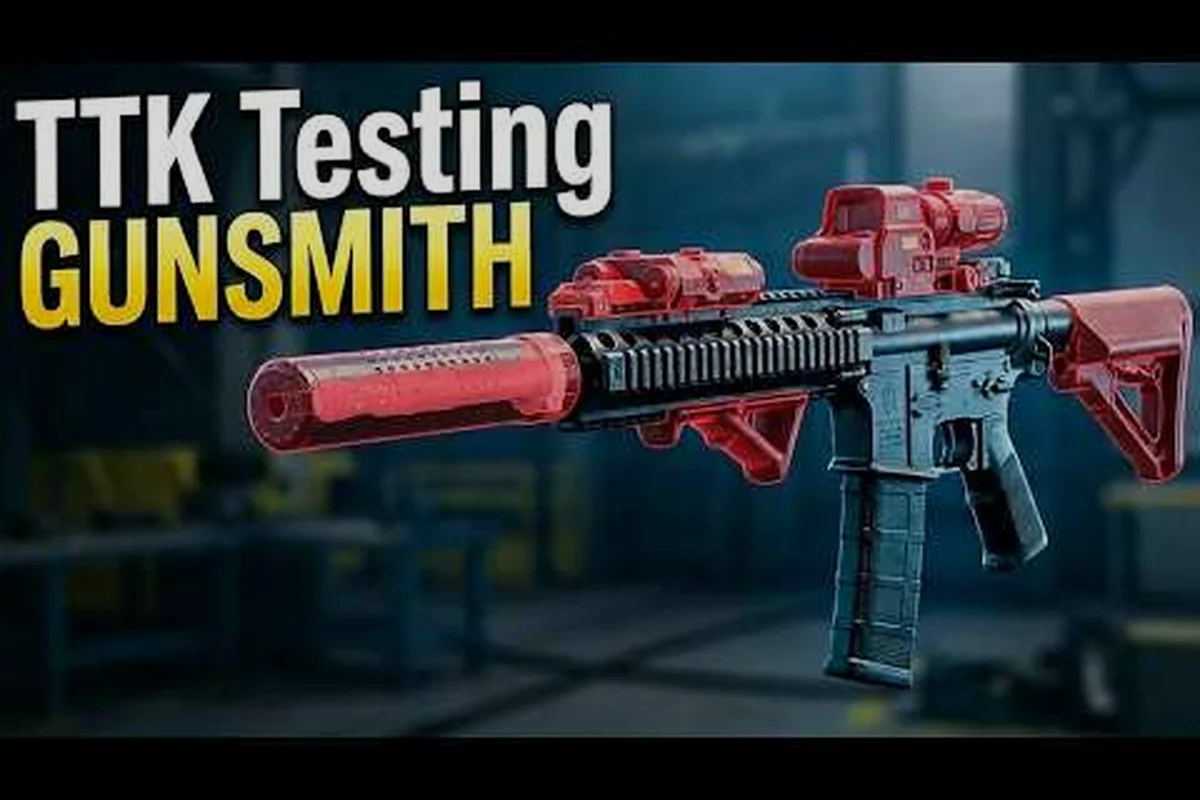
The TTK Testing best gun build is not a single magic loadout copied from a pro, but a chain of small gunsmith decisions that turn a stock rifle into a tuned tool. The official TTK Testing page on Roblox describes the game as a tactical FPS focused on time-to-kill tuning and realistic weapon handling, which is why the gunsmith is the single biggest power lever in the entire sandbox. Every slot you change shifts a stat the TTK math actually cares about: muzzle velocity, recoil climb, reload interval, and round count before cover.
The gunsmith update, tracked since the V0.04 showcase by community creator Cr8zNinja, introduced battle rifles, DMRs and sniper rifles into the gunsmith rotation, expanded the optic, grip and muzzle attachment slots, and made reload and ammo modifications first-class slots rather than hidden perks. As of the live V0.09 build, the gunsmith is the only sanctioned way to alter a weapon's TTK curve, and every attachment tier is earned through matches rather than purchased with premium currency. That makes build order as important as the parts list itself: pick a platform first, then a role, then commit the parts.
Players who treat the gunsmith like a checklist end up with a Frankenstein gun that aims soft and reloads slow. Players who treat it like a role build, choosing each part to solve a specific problem with that platform's recoil or capacity profile, end up with the TTK Testing best gun build for their playstyle. The rest of this guide walks through that role-based approach, slot by slot, so you can replicate it on any weapon class.
TTK Testing Attachment Tier List and Slot Logic
The TTK Testing attachment tier list ranks every part by how much it shifts the platform's effective TTK, not by raw stat numbers. A part that trims 8% of vertical recoil on a battle rifle is worth more than a part that adds 3% muzzle velocity on a DMR already past its damage dropoff cliff. Community testing shared in PetriFyTV's hands-on TTK Testing gunsmith update breakdown treats each attachment slot as a layer: muzzle sets the recoil floor, optic sets the engagement range, grip and stock shape the recovery curve, magazine and ammo set the sustained pressure, and reload mod sets the rhythm between kills.
| Attachment Slot | Primary Stat Shifts | Tier S Examples | Tier C Examples |
|---|---|---|---|
| Muzzle | Recoil, sound, muzzle velocity | Compensator, muzzle brake | Heavy suppressor (range maps only) |
| Optic | Sight picture, effective range | Red dot, holographic, low-power ACOG | High-power sniper scope on CQB kits |
| Grip | Vertical and horizontal recoil | Vertical grip, angled grip | Stubby grip (only on high-ROF SMGs) |
| Stock | ADS speed, recoil control | Light stock, marksman stock | Heavy stock on run-and-gun kits |
| Magazine | Round count, reload interval | Extended mag, quick mag | Standard mag on reload-sensitive DMRs |
| Ammo Mod | Damage profile, penetration | Hollow point, armor-piercing, subsonic | Default ball (only on meta kits) |
| Reload Mod | Reload speed, partial reload behavior | Speed loader, fast mag | Default (only on LMGs) |
The TTK Testing attachment tier list is built so that slot S in one row is rarely the right answer if slot S in the row above it conflicts. A compensator on a DMR with a heavy marksman stock over-corrects and locks the crosshair into a slow side-to-side wobble. Reading the tier list as a vertical ladder, not a horizontal shopping list, is what separates a tuned best gun build from a stat-maxed mess.
Muzzle and Optic Pairings
The muzzle slot is the first decision because it sets the recoil ceiling the rest of the build has to manage. On 5.56 battle rifles the Compensator is the strongest S-tier pick, cutting vertical climb by roughly a third and letting the grip slot work on horizontal sway instead. On 7.62 DMRs the Muzzle Brake does the same job in reverse, taming the slower but harder side kick that 7.62 platforms produce. Pair the muzzle to the optic, not the platform: a red dot plus compensator reads as a tight CQB kit, while a low-power ACOG plus muzzle brake reads as a mid-range marksman kit, and the two kits want different grips, stocks and mags downstream.
TTK Testing Reload Speed Mods and Magazine Choices
The TTK Testing reload speed mods are the most underestimated slot on the whole gunsmith, because reload time directly caps sustained TTK. A gun that kills in 220 ms but takes 2.6 seconds to reload loses its time-to-kill edge the moment a fight goes past one magazine. Community data shared in Cr8zNinja's V0.04 showcase shows that swapping to a Speed Loader or Fast Mag mod can recover 0.3 to 0.7 seconds of reload, which over a five-kill streak is the difference between holding an angle and being caught mid-reload by a push.
The TTK Testing extended mag sits in a different tier and trades reload speed for round count, which matters more on LMGs, SMGs and the new V0.09 battle rifles that burn through 30-round mags in three seconds of full auto. The table below maps the reload and magazine trade so you can read your own build at a glance.
| Build Goal | Magazine Pick | Reload Mod Pick | Net Effect |
|---|---|---|---|
| CQB run-and-gun | Standard mag | Fast mag | Short reload, fast swap back into fight |
| Objective holding | Extended mag | Default reload | More rounds per cover window, slower rep |
| Marksman mid-range | Standard mag | Speed loader | Maintains hand-load rhythm between picks |
| Suppression role | Extended mag | Default reload | Sustained fire over reload cadence |
A common mistake players make is stacking a TTK Testing extended mag with a fast mag, which the gunsmith does not allow on most platforms because the slots share a weight budget. If you need both, switch to a light stock and accept a small recoil hit, or run a Quick Mag magazine variant that adds five rounds and a partial reload feature without the full extended mag penalty. That hybrid is the single most common best gun build trick in the current meta.
Ammo Mod Synergy
The TTK Testing ammo mod slot is the last layer because its effect only matters once the muzzle, optic and grip have already locked in the platform's range profile. Hollow Point trades one damage tier for a sharper limb-shot multiplier, which is strong on CQB SMGs and weak on long-range DMRs where the limb multiplier never fires. Armor Piercing does the opposite, pushing damage through cover at the cost of raw flesh damage, which is why it pairs so well with a marksman stock and ACOG. A meta best gun build always reads as a chain: muzzle plus optic sets the range, grip plus stock sets the recovery, magazine plus reload mod sets the cadence, and ammo mod sets the damage profile against the targets you actually face.
TTK Testing Gunsmith Update Weapon Class Priorities
The TTK Testing gunsmith update reshuffled the meta when it expanded the weapon class roster to include battle rifles, DMRs and sniper rifles alongside the original SMG and LMG platforms. Each class now has a clear role in the best gun build ladder, and the same attachment logic above produces a different kit per class because the recoil, magazine and damage baselines are all different.
| Class | Effective Range | Strength | Weakness | Best Gun Build Style |
|---|---|---|---|---|
| SMG | 0–25 m | Fastest TTK up close | Falls off past mid range | CQB extended mag + compensator + red dot |
| Battle Rifle | 15–55 m | Balanced recoil and damage | Mediocre at both ends | All-rounder ACOG + muzzle brake + vertical grip |
| DMR | 40–90 m | One-tap upper torso | Slow follow-up shots | Marksman stock + speed loader + armor piercing |
| Sniper Rifle | 70 m+ | Highest single-shot TTK | Useless in CQB | Heavy barrel + high-power scope + subsonic ammo |
| LMG | 20–60 m | Sustained fire and suppression | Long reload, slow ADS | Extended mag + compensator + default reload |
Community testing reported by players on the official TTK Testing DevForum thread shows the battle rifle class currently sits at the top of the TTK curve in 2026 because it covers both the 15 m and 55 m engagement bands without a strict reload penalty. That is why so many best gun build screenshots in the community feature a tuned AR-platform rather than a sniper or LMG.
Choosing a Platform First
The single biggest mistake in the TTK Testing best gun build conversation is choosing attachments before choosing a platform. The gunsmith allows you to tune any class, but it cannot fix a platform whose base TTK curve does not match the maps you actually play. On close-quarters maps like the CQB arena added in the V0.09 build, a tuned SMG outperforms a tuned DMR every time, because the extended mag and compensator cannot manufacture range the SMG does not have. Pick the class whose base range band matches the mode you queue, then build the best gun build around that class.
Step-by-Step TTK Testing Best Gun Build Path
A repeatable best gun build path is the difference between a loadout you trust and a loadout you keep swapping mid-match. The five-step process below is what high-TTR players use to land a tuned build inside a single sitting, and it is the same pattern the community showcase videos follow when they show off a fresh gunsmith setup.
| Step | Action | Why It Matters |
|---|---|---|
| 1 | Pick a weapon class that matches your main mode | Class decides the range band the build can cover |
| 2 | Choose a role within that class (CQB, marksman, suppressor) | Role decides which stat you are willing to trade |
| 3 | Lock the muzzle and optic first | These two slots fix the recoil floor and engagement range |
| 4 | Add the grip and stock for the recovery curve | Recovery decides how fast you can land follow-up shots |
| 5 | Finish with magazine, reload mod and ammo mod | Last three slots set the sustained TTK rhythm |
Work through the steps in order, and resist the urge to chase a higher-tier part from a later step that breaks a tier from an earlier step. A C-tier optic in the right range band is always better than an S-tier optic that pushes the build into a range band you cannot support with the platform you started with.
Saving and Swapping Builds
The gunsmith lets you save a build per weapon, which means you can keep one CQB SMG build, one mid-range battle rifle build and one long-range DMR build without paying any reload or part cost. Most community screenshots of the TTK Testing best gun build show three saved builds per player, which lines up with the three role categories above. If you find yourself swapping attachments every match instead of swapping weapons, the build is wrong, not the parts.
Advanced TTK Testing Best Gun Build Tuning
Once the role build is locked, the next layer of tuning is stat-by-stat micro-adjustment using the gunsmith preview. The preview shows recoil pattern, reload interval and damage dropoff curve, and reading those three curves is what separates an average build from a tournament-grade one. The recoil pattern preview in particular tells you whether the compensator plus vertical grip is over-correcting into a side wobble, which the tier list alone cannot catch.
| Stat to Watch | What It Tells You | Common Fix |
|---|---|---|
| Vertical recoil % | How much the crosshair climbs per shot | Adjust muzzle or grip |
| Horizontal recoil % | How much the crosshair kicks sideways | Swap vertical grip for angled grip |
| ADS speed (ms) | How fast you can react to a peek | Drop heavy stock for light stock |
| Reload interval (s) | How long you are exposed between mags | Add fast mag or speed loader |
| Damage at 30 m | Effective damage at typical mid-range | Switch ammo mod or platform |
Community data published by players in the V0.04 showcase highlight that subsonic ammo plus a heavy marksman stock produces the most stable long-range DMR build, while armor piercing plus a vertical grip is the strongest anti-cover battle rifle build. Neither combo is the right answer for every map, which is why saving three builds per platform class is more valuable than chasing a single god-tier best gun build that only works on one map.
Reading the TTK Curve in Match
A real best gun build shows up in the kill feed, not in the gunsmith screen. Track your average kill range and average engagement duration across five matches, then compare them to the platform's damage dropoff curve from the preview. If most of your kills happen past the platform's damage cliff, the optic is wrong. If most of your kills happen in CQB and the gun still loses to SMGs, the muzzle and reload mod combo is wrong. That match-time feedback loop is the fastest way to land a tuned build without theory-crafting for hours.
Putting It All Together
The TTK Testing best gun build is a layered system, not a single recipe: pick a platform that matches your mode, lock the muzzle and optic to set the range, tune the grip and stock for the recovery curve, then finish with magazine, reload and ammo mods to set the sustained cadence. Read the TTK Testing attachment tier list as a vertical ladder rather than a shopping list, and remember that the TTK Testing gunsmith update gave every part a clear role in the time-to-kill math, so the wrong part in the right slot will cost more than the right part in a slightly suboptimal slot.
The TTK Testing extended mag and reload speed mods are the most common upgrade path because they are the cheapest stat gains per part slot, but the biggest swings in TTK still come from muzzle and optic choices. The TTK Testing ammo mod slot is the finisher, not the foundation, and a hollow point or armor piercing round on a poorly tuned platform will still lose to a stock battle rifle with the right muzzle and grip. Build the platform first, build the role second, and let the meta screenshots follow the practice rather than the other way around. Build the platform first, build the role second, and let the meta screenshots follow the practice rather than the other way around, which is exactly why the numbers in our Ttk Testing Muzzle Attachments breakdown only matter once a baseline build already handles recoil and range.
Frequently Asked Questions
What is the single best gun build in TTK Testing right now?
The most consistent 2026 meta build is a tuned battle rifle with a Compensator, low-power ACOG, vertical grip, marksman stock, standard mag, fast mag and Armor Piercing rounds. It covers the 15–55 m band where most PVP modes are decided and holds its own at close range thanks to the compensator. Swap to an SMG or DMR variant for maps that demand a different range band.
Where do I unlock the gunsmith attachment slots?
Every attachment tier is earned through match XP rather than Robux, so the only way to unlock higher-tier parts is to play the modes tied to each weapon class. The official page confirms that the roadmap is co-op PVE squad AI, story missions, team PVP and Ground War, and each mode feeds class-specific XP. Stick to one class until the relevant slots open, then switch to the next class once the build is locked.
Are the reload speed mods worth it on every platform?
No. The TTK Testing reload speed mods are strong on DMRs and battle rifles that have a 2.4 s or longer base reload, but they are wasted on LMGs whose 4 s reload is not the real bottleneck. Run a Speed Loader on DMRs, a Fast Mag on battle rifles, and the default reload on LMGs. Pair the reload mod with a TTK Testing extended mag on platforms that burn through 30 rounds in under four seconds, otherwise keep the standard mag to keep the reload short.
Does the ammo mod slot actually change TTK that much?
Yes, but only inside the right range band. The TTK Testing ammo mod slot shifts damage against armored or unarmored targets and the limb-shot multiplier, so Hollow Point is a real upgrade in CQB but a small downgrade past 50 m. Pick the ammo mod that matches the range band you set up with the muzzle and optic, not the one with the highest tier-list rating in isolation.
Can I copy a pro's best gun build exactly?
You can copy the parts list, but the role build only works if the platform and playstyle match the pro who shared it. A streamer who plays Ground War with a tuned DMR is not going to give you the same results on a CQB arena even with the exact same parts. Steal the role logic, not the screenshot, and rebuild the kit around your own average engagement range.